
How "feminize your opponent" emerges in the Trump era
"Low-T Talarico" is a new spin on an old strategy

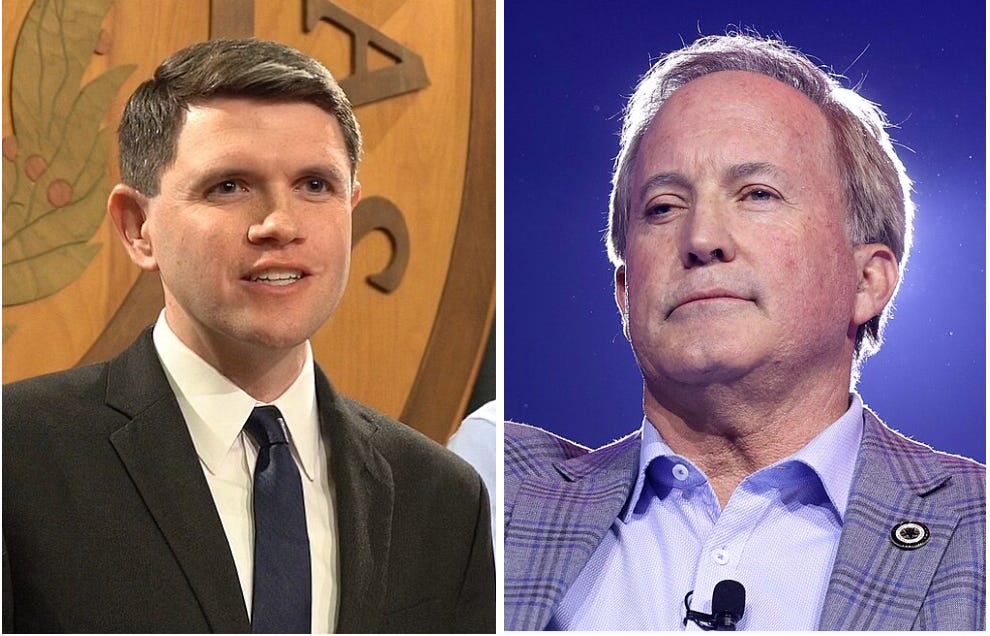
Ken Paxton hadn’t even won the Republican Senate runoff in Texas before his campaign had nicknames ready for the opponent he’d face in November.
“Low-T Talarico.” “Six Gender Jimmy.” “Tofu Talarico.”
Paxton beat incumbent John Cornyn last week in the GOP primary, setting up a general election against James Talarico, a Democratic state representative who has become something of a Rorschach test for the modern Republican masculinity playbook, as Danielle Kurtzleben at NPR and Grace Segers at TNR have reported. From Kurtzleben:
White House advisor Stephen Miller used “transgender” as an insult, telling Fox News that Talarico is the Democrats’ “first transgender Senate candidate.” [But] Talarico is not transgender.
“He’s clearly transitioning into a female,” Miller said. “When Talarico goes in for a blood test, when he gets a physical, blood doesn’t come out. Soy milk comes out.”
In the era of Trump, schoolyard taunts that implicate gender aren’t surprising. But behind them is a coherent political strategy with a much longer history than Trump, and the nicknames are only half of it. The other half? Making men feel that their masculinity threatened.
What does “feminize your opponent” mean?
Feminizing your opponent is simple: A deliberate effort to cast your opponent as insufficiently male (e.g., too soft, too weak, or too in touch with his feelings). Another word for it: “unmanning.” If he can’t be a man, the logic goes, how can he govern?
Why is it effective?
While voters evaluate candidates on presumed policy positions, they also evaluate them on an intuitive sense of whether someone looks like a leader. And in the United States, that mental image of a leader is stubbornly and persistently a man.
A famous study called “Think Manager, Think Male,” shows that the association between leadership and manhood is powerful. Virginia Schein found that both men and women associated the characteristics needed for managerial success — things like competence, decisiveness, and leadership ability — far more strongly with men than with women. The implication was that the mental prototype of a leader was essentially male by default, meaning women faced a built-in cognitive disadvantage when being evaluated for leadership roles simply because they didn't match the schema. It's been replicated many times across decades and countries, with some variation (.e.g., women’s attitudes have shifted somewhat, men much less so), and it’s the foundational empirical backbone for why feminizing a male opponent works. It works because unmanning your male opponent distances him from that default male-leader prototype.
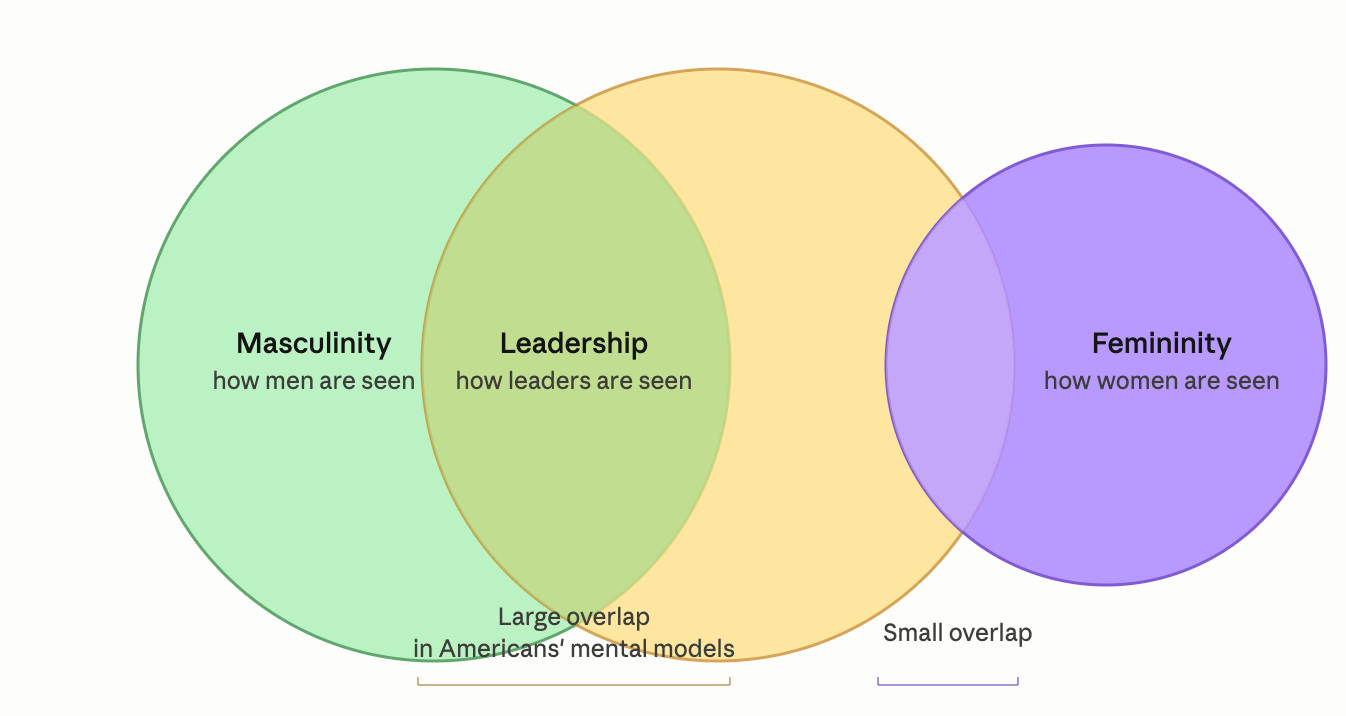
Another reason unmanning is effective is that American elections naturally lend themselves to oppositional dynamics, and gender provides one of the most readily available and culturally resonant axes (masculine versus feminine), even when both candidates are men. It’s even more salient in primaries, because party identification is essentially moot when Democrats are running against Democrat, and Republicans against Republicans.
When the gender dichotomy is especially salient, the game becomes about positioning yourself as the more masculine one. Feminizing your opponent is an attempt to sever the psychological link between your opponent and the job you’re both running for, to strengthen your own.
When a candidate’s presentation doesn’t match voters’ mental schema of what a leader looks like, it creates cognitive dissonance that voters tend to resolve not by updating their expectations, but by discounting the candidate. Think of it less like a conscious judgment and more like a feeling that something is off that attaches itself to the candidate rather than to the voter’s own assumptions. For voters deeply invested in traditional gender norms, the effect is even sharper: a man who doesn’t perform masculinity “correctly” can feel like a challenge to a worldview they hold dear.
And the attacks on Talarico (so far) do double duty. “Low-T Talarico” and “Tofu Talarico” aren’t just random emasculations. They tap into two of the most culturally charged touchstones in today’s gender culture wars: transgender identity and veganism. Both of these topics carry enormous symbolic weight on the ideological right, right now. So these nicknames both feminize Talarico, triggering those psychological penalties, and function as rallying signals for voters already primed to see plant-based eating and hormone discourse as proxies for a larger cultural battle, which also activates a sense of threat.
Masculinity threat as an accelerant
“Masculinity threat” refers to the psychological experience of having one’s masculinity called into question. Unlike femininity, masculinity in American culture is understood as something that must be earned and publicly demonstrated. Studies find that when men feel it slipping, they engage in compensatory behaviors like aggression and dominance displays. And even support for perceived hypermasculine political figures.
Researchers tested this experimentally before the 2016 election. Men whose masculinity was threatened showed increased desire for a masculine president, not just a man. They found that this condition increased support for Trump and decreased support for Clinton. The threat activated a specific response: reach for the dominant male as a symbolic anchor.
In other words, the attacks on Talarico aren’t just about framing him as less manly and therefore less capable for the job. They are also about activating masculinity threat.
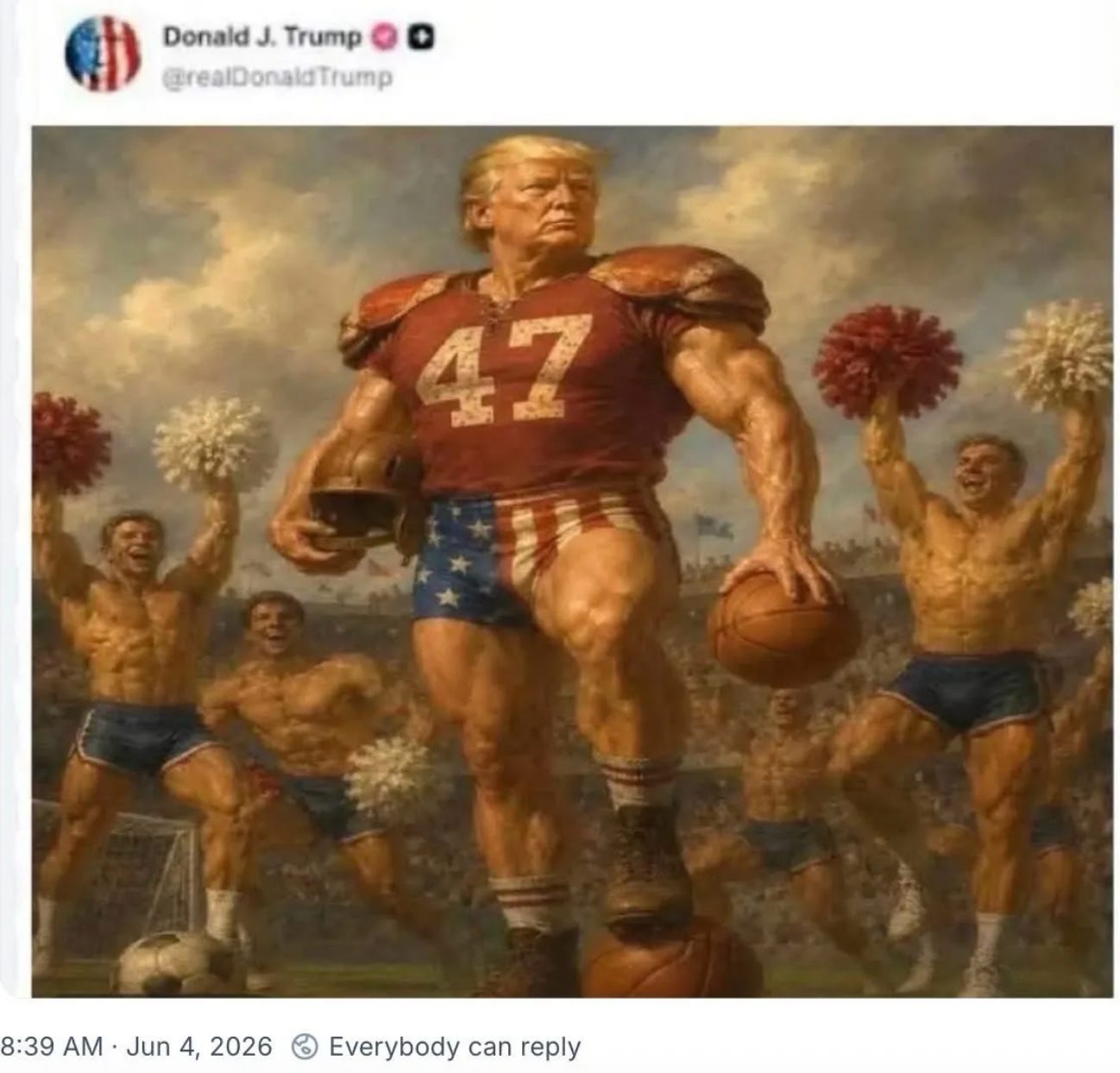
Trump’s age and physical ailments means his masculinity, and therefore his supporters’, is nearly always threatened. It’s why his campaign and surrogates engage in compensatory strategies, often AI enabled, like this (now deleted) Truth Social post from Trump over the weekend:
Feminizing opponents has a long history
The concept of “feminize your opponent” is not new, even if the attacks on Talarico take on a new flavor. Here are some key races:
1840 — Van Buren vs. Harrison | This is one of the earliest documented cases of feminizing-your-opponent in American electoral politics. The Whigs mocked Van Buren as an effete dandy who drank from golden goblets in the White House while the people suffered from tough times, in contrast to Harrison’s carefully cultivated log cabin, man-of-the-people image. Here, aristocracy was soft, while ruggedness was strong.
1988 — Bush vs. Dukakis | In this race both candidates were simultaneously trying to avoid characterizations as feminine. Bush suffered from a reputation as a “wimp” who in 22 years of public life had failed to establish his toughness, which was the subject of a Newsweek cover story entitled “Fighting the ‘Wimp Factor’.”
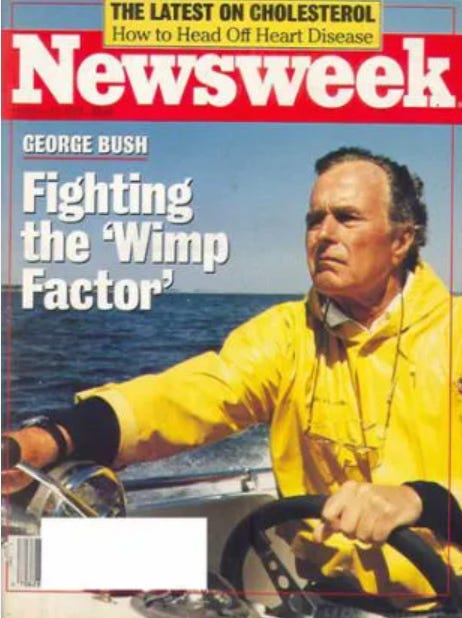
Bush then turned around and used the Willie Horton ad and the famous Dukakis in a tank photo to cast his opponent as soft.
2004 — Bush vs. Kerry | The 2004 presidential election is a case study I wrote about for my book, Masculinity, Media and American Presidency. Kerry, a Vietnam veteran, and lifelong athlete had both of these aspects of his personality weaponized against him. The Swift Boat Veterans for Truth campaign cast Kerry’s combat experience as fraudulent, and his post-war testimony against the war as betrayal. Images of him protesting the war were ubiquitous. But more subtler feminization was happening in the margins. Kerry was mocked for windsurfing and for allegedly using Botox. A story from the time at USA Today entitled “Election is turning into a duel of manly men,” said Bush was “plain talking” and had “swagger,” and that Kerry would “never be Joe Six Pack.”
2016 — Republican Primary | During the 2016 Republican primary there was no shortage of this strategy on display. Rick Perry challenged Trump to a pull-up contest, Trump repeated an audience member’s comment that Ted Cruz was a “pussy,” and Trump called Marco Rubio “Little Marco,” with Rubio responding by suggesting Trump had small hands (and everyone knew what that meant). The gloves, such as they were, had never really been on.
2016 — Clinton vs. Trump | The 2016 presidential election added a new wrinkle: what happens when one of the candidates is a woman? Trump made stamina and physical dominance central to his attacks, and explicitly questioned whether she had the “presidential look.” And when Clinton fainted at the 9/11 Memorial a few months before the election, the “stamina” label took on a renewed meaning for many audiences.

2020 — Biden vs. Trump | In 2020, Trump tried to run the same playbook against Joe Biden. Trump mocked him as “Sleepy Joe,” tried to cast him as mentally diminished, and when Biden spent much of the campaign away from public events during the COVID-19 pandemic, Trump’s team treated it as evidence of fragility. But Biden responded by framing his behavior as an example of “real” manhood, because real men project and care for others. This ad from The Lincoln Project really boils that communication strategy down:
That 2020 strategy by Biden might be a winning one for Talarico, who responded last week to the gendered name calling with this:
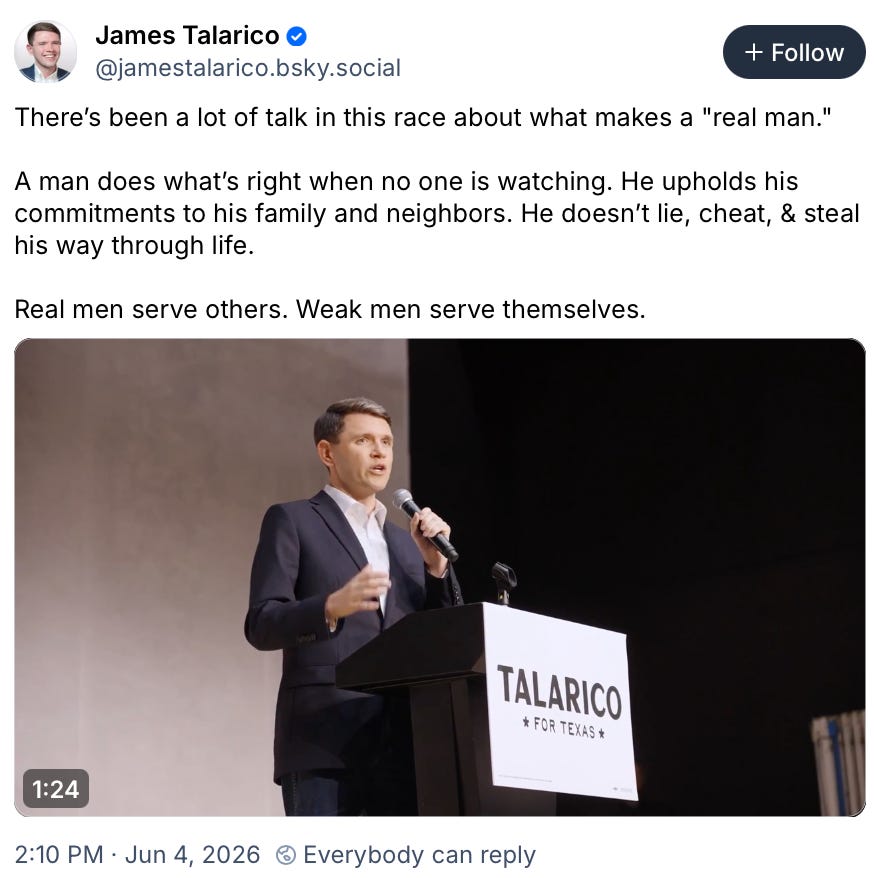
Talarico's response to Paxton’s attacks is instructive. Rather than overcompensating or out-machoing the attacks, he reframed the terms entirely. “Real men serve others. Weak men serve themselves.” It's only eight words, but as a counter to “Low-T Talarico,” it might be enough.
All of this is also incredibly partisan. The Democratic Party, which is literally made of many more women, is less demanding of masculine candidates, and more likely to value femininity in their leaders. That’s something I’ll cover in future post.
What I’m reading and you should too
The New Republic, Grace Segers. “The Trumpian Machismo Infecting the Texas Senate Race.” (June 1, 2026).
I spoke with Grace for her story, and she gets insights from other experts, too.
NPR, Danielle Kurtzleben. “What it means to be a man is a theme in Texas Senate race as Paxton attacks Talarico" (May 30, 2026).
Danielle gets into even more gendered attacks in the race thus far, and talks to some experts on the topic, with great insights.
Of Boys and Men, Richard Reeves. “What gender war?” (May 22, 2026).
Reeves gets into lots of data that shows the gender wars raging online aren’t showing up everywhere, which is something that we should take time to recognize.
New York Times, Jonathan Bernstein and John Guida. “Trump is getting worse at his job.” (June 4, 2026).
Jonathan talks to Times editor John Guida about the many setbacks and failures Trump is experiencing. It does a great job of putting his presidency in historical context.New York Times, Jamelle Bouie. “America broke something when it gave Trump a second chance.” (June 3, 2026).
“The American people broke something when they gave Trump a second chance in office. And there is no going back to the Union as it was. If Democrats hope to lead the nation to any kind of recovery, much less renewal, they must understand and internalize this fact of the matter.”
Excellent post, Meredith! Among other things, I think it helps explain why female Democratic candidates who are veterans often overperform, electorally. Mikie Sherrill, Abigail Spanberger, and Elissa Slotkin are only just a few of the examples of Democrats who undermine the notion that women can't be strong leaders.
Good article. It is very instructive to see the historical timeline of how "masculinity" is a through-line in American politics. As a political wedge that will separate male voters from Democrats, Republicans know that threatening male identity is a political winner for them, especially during economic downturns when men's ability to be the breadwinner is threatened. However, it is still a political and rhetorical ploy which can be effectively rebutted, assuming the rebuttal actually gains traction. So, Republicans do two things.
They make the accusation, then they undermine the rebuttal. In a way, it seems they spend more time insulating their male voters from hearing contradictory information than just making the accusation. Talarico is obviously well-trained in communication and narrative combat. He knows you must never, ever play the game Republicans set up. Because that is actually the whole point. Get Talarico to start trying to prove the negative of their assertion and then they control him. Way too many Democratic candidates have fallen for this. But, Talarico was a middle-school teacher. He knows you absolutely cannot cede your authority in situations like this or the kids (the Republicans) will run all over you.
The more effective response therefore is to question their premises, put the goal posts back where they belong and force Republicans into defending their absurdities. Talarico does this and does it well. The issue now is whether voters absorb his reset and thereby reject Republican mis-frames.
Also, I hypothesize that women have these guys' number. And women, including Republican women, seem to be ready for this fight. They are Talarico's secret weapon here in Texas.